Why Your SMART Goals Aren’t Working
For years, we’ve been told that the key to change is setting SMART goals — specific, measurable, achievable, relevant, and time-bound. And on paper, that advice makes sense.
In fact, many people are already doing exactly what they were taught.
They set goals like:
- “Reduce my stress over the next two months.”
- “Learn a new skill or finish a course this year.”
- “Be more present and intentional in my relationships.”
These aren’t careless goals. They’re thoughtful. Meaningful. Often deeply personal.
And yet, many capable people keep setting goals like these… and quietly letting them go.
Not because they don’t care.
Not because they lack discipline.
The problem is more subtle than that.
SMART goals work well for projects — things with a clear start, finish, and external deliverable.
But when it comes to personal change — stress, learning, confidence, recovery, relationships, or purpose — they’re often aimed at the wrong layer of change.
And no amount of discipline can compensate for that.
The Hidden Problem With “Goals”
Part of the confusion comes from how casually we use the word goal.
We use it to mean:
- a result we want
- a direction we’re choosing
- a behaviour we’re trying to repeat
- or even the kind of person we hope to become
When all of those meanings get collapsed into a single target, motivation becomes fragile — and progress feels inconsistent.
The issue isn’t that goals are too vague.
It’s that they’re often doing too much work.
To set better goals, we don’t need more precision.
We need better aim.
A Simple Orientation
(Before We Go Further)
A more helpful way to think about change is to separate goals into layers — each with a different job.
Think of change as a stack, not a single target:
- Outcomes frame direction.
- Intentions choose the path.
- Progress measures impact.
- Habits do the work.
- Identity emerges over time.
When goals fail, it’s usually because one of these layers is missing, overloaded, or asked to do the wrong job.
SMART goals tend to overemphasize the first layer — outcomes — while leaving the rest implicit or unsupported.
Progress exists so you don’t have to wait for outcomes to feel successful.
Where SMART Goals Go Wrong
SMART goals are designed to make outcomes clearer. They help you define what you want and when you want it. And for projects — launching something, completing a certification, hitting a financial milestone — that works well.
The problem is that when we apply the same logic to personal change, SMART goals end up doing almost all the work at the outcome layer, and very little at the layers where change actually happens.
They tell you where you want to end up, but not:
- how to prioritize your energy
- how to adapt when life shifts
- or how to build daily patterns that make progress sustainable rather than forced
In practice, this often leads people to aim outcomes directly at themselves:
- “Be less stressed by March.”
- “Learn AI in three months.”
- “Be more present in my relationship this year.”
These are understandable desires.
They’re also not executable.
When outcomes are treated like instructions, the only tool left is pressure.
The Emotional Cost of Outcome Pressure
When outcomes become the primary focus, the nervous system hears a very specific message:
Something about me isn’t good enough yet.
From a neuroscience perspective, this matters. The brain doesn’t just track goals — it tracks threat and safety. When success is framed as a future condition (“I’ll be okay when I hit this target”), the stress response is subtly activated.
Motivation may spike briefly.
Anxiety rises alongside it.
If you’ve ever set a goal you genuinely cared about — only to feel anxious, inconsistent, or quietly disappointed with yourself — this isn’t a motivation problem.
It’s a structural one.
Anxiety
When Goals Become Threats
Outcome-heavy goals often create a low-grade sense of urgency. The brain shifts into monitoring mode — constantly scanning for progress, setbacks, or signs of failure.
Research in stress and motivation shows that this kind of pressure narrows attention and reduces cognitive flexibility. Instead of learning and adapting, people become tense, reactive, and risk-averse — the opposite of what long-term change requires.
(Translation: you try harder, but think worse.)
Inconsistency
Why Motivation Comes in Bursts
From a positive psychology lens, sustainable motivation is fueled by autonomy, competence, and meaning. Outcome pressure undermines all three.
When progress feels externally imposed or conditional, effort tends to arrive in short bursts — followed by fatigue, avoidance, or reset cycles.
Self-Judgment
When Goals Turn Into Identity Tests
When goals are treated as verdicts, missed targets quietly become evidence.
“I said I’d do this.”
“I should be further along.”
“What’s wrong with me?”
Over time, the brain begins to associate goal-setting itself with judgment — which is why so many people stop revisiting goals they once cared deeply about.
Why This Matters
None of this means outcomes are bad.
It means they’re incomplete.
Outcomes can point the way — but when they carry all the emotional weight, they create strain without support.
In the next sections, we’ll look at three common SMART goals — reducing stress, learning a new skill, and improving relationships — and walk through how the same goals work very differently when they’re aimed at the right layers.
From Outcomes to Identity
The 5 Steps That Make Change Stick
Most goal systems jump straight from outcomes to habits and hope identity follows.
That’s where things break.
A more reliable path moves through five distinct steps, each with a specific job. When they’re in the right order, change stops feeling forced and starts feeling coherent.
Here’s how outcomes turn into identity — one layer at a time.
1) Outcomes Frame Direction
Outcomes answer a simple but important question:
What would success look like if things went well?
They point forward. They help you aim.
But outcomes are not instructions.
They work best when they:
- inspire without pressuring
- describe direction rather than control
- remain flexible over time
Used properly, outcomes function like a compass heading, not a deadline you have to outrun.
This is where SMART goals actually belong.
SMART goals work best as outcomes, not commands.
“Reduce my stress from a 7 to a 3 in 8 weeks” gives direction — but becomes harmful when treated as an order the body must obey.
Held lightly, the same goal becomes an aim:
“I’m orienting toward less stress and more ease over the next couple of months.”
This removes pressure, leaves room for regulation and learning, and naturally invites the next layers of change.
SMART goals help you aim — but real change requires intention, feedback, and execution.
2) Intentions Choose the Path
This is the layer SMART goals leave out — and where everything changes.
Intentions don’t replace outcomes.
They translate them into present-moment choice.
An intention answers a more human question:
Given my life, my energy, and my values — what am I choosing to prioritize right now?
Intentions:
- reduce threat
- restore autonomy
- create consistency
- surface honest trade-offs
They turn goal-setting from a demand into a direction.
Try This (2 Minutes)
Take one SMART goal you’re currently holding and ask:
- What am I actually trying to feel, protect, or move toward?
- What discomfort am I willing to tolerate to move in that direction?
Rewrite the goal as an intention that names direction + trade-off.
Example
Instead of:
“Finish the course”
Try:
“Learn at a pace that keeps me curious rather than overwhelmed.”
3) Progress Measures Impact
Before habits fully install — and long before outcomes arrive — something else is essential:
You need a way to recognize that the direction you chose is actually landing.
Progress is not pass/fail success.
It’s impact.
Progress asks a quieter, more useful question:
Is this intention changing how I’m showing up — in my life and relationships?
To answer that, you don’t measure outcomes.
You define identity-level signals that reflect real change.
How Progress Is Measured (Impact, Not Pressure)
Progress shows up through a small set of concrete indicators:
- Principles
How is my mindset or inner stance shifting?
(curiosity over judgment, stability before intensity) - Roles
How is this showing up across the core areas of my life?
(energy, work, love) - Relationships
How is this affecting my relationships with real people?
(partner, children, friends, peers, colleagues, boss) - Strengths
What capacity, skill, or quality is developing?
(confidence, learning agility, presence, resilience) - Challenges
What pattern or roadblock is softening over time?
(avoidance, reactivity, self-doubt, anxiety, pain)
These are not metrics to optimize.
In the app, these become your Progress Items — the things you actually track week to week.
Why Progress Changes the Experience of Goals
Progress replaces judgment with trends.
It makes invisible change visible.
Instead of asking:
“Did I succeed?”
You begin asking:
“Is this direction taking hold in how I live, work, and relate?”
That shift matters.
When people can see impact before perfection:
- motivation steadies
- self-trust grows
- habits feel meaningful
- identity shifts naturally
Progress doesn’t rush change.
It confirms it — gently, honestly, and over time.
4) Habits Do the Work
With direction chosen and impact being observed, habits finally have the right job.
Habits are the execution layer.
They:
- turn intention into action
- reduce reliance on motivation
- make alignment more likely than avoidance
Good habits aren’t heroic.
They’re small, repeatable, and realistic — even on low-energy days.
Habits don’t prove who you are.
They practice who you’re becoming.
5) Identity Emerges Over Time
Identity is not something you set at the beginning.
It’s what becomes visible when:
- outcomes point the way
- intentions guide choices
- habits repeat
- progress reflects impact
Over time, the internal story shifts from:
“I’m trying to change.”
to:
“This is how I show up.”
Identity isn’t declared.
It’s earned through alignment.
The Key Reframe
Most people try to aim straight at identity — or force outcomes to do all the work.
This model does neither.
Instead, it lets identity emerge naturally from repeated, aligned action:
- supported by intention
- grounded in realistic habits
- validated by visible impact
That’s why it feels calmer.
That’s why it survives plateaus.
And that’s why it lasts.
SMART goals can help you aim.
But alignment across layers is what actually changes who you become.
Three Common SMART Goals — Reworked the Right Way
Every year, people set goals like these:
- Stress / Health
“Reduce my stress from a 7 to a 3 in 8 weeks.” - Growth / Learning
“Learn AI by completing an online course in 3 months.” - Relationships / Presence
“Be more present and intentional in my relationships.”
On the surface, these goals look solid.
They’re thoughtful. Meaningful. Often deeply personal.
They also fail far more often than people expect.
Not because the goals are bad — but because they rely almost entirely on outcomes to do the work of change.
Each one describes where someone wants to end up, but not:
- how to relate to discomfort along the way
- how to recognize progress before the outcome arrives
- or how to build identity without pressure or self-judgment
As a result, motivation fades in the messy middle — long before the finish line.
What follows isn’t a critique of these goals.
It’s a translation.
We’ll walk through each one using the same five-step sequence — showing how the same goal becomes workable, humane, and sustainable when it’s aimed at the right layers.
Example 1: Reducing Stress
1) Outcome — Frame Direction
“Experience less stress and more ease in daily life.”
This gives direction without turning the body into a project.
2) Intention — Choose the Path
“Prioritize regulation and energy protection during my days — even when things feel busy.”
Trade-off made explicit:
I’m willing to slow down instead of pushing through everything.
3) Progress — Show Impact (Before Stress Drops)
Instead of waiting for stress levels to fall, progress is tracked through impact signals:
- Principle: Stability Before Intensity
→ choosing pacing over urgency - Role (Energy):
→ faster recovery after stressful moments
→ fewer afternoon crashes - Relationship: Partner / Children
→ fewer reactive moments
→ quicker repair after tension
Progress question becomes:
“Am I responding with more steadiness?”
Not: “Am I calm yet?”
4) Habits — Do the Work
- 1–2 minutes of slow breathing during the day
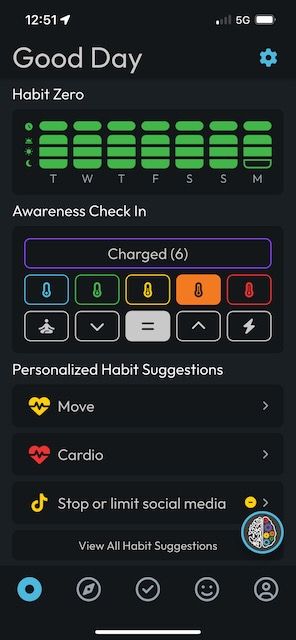
- brief Awareness Check-Ins
- gentle movement
- earlier digital shutdown a few nights per week
Habits don’t eliminate stress.
They practice a regulated response to it.
5) Identity — Emerge Over Time
From: “I need to manage my stress.”
To: “I know how to support my nervous system.”
Example 2: Learning AI
1) Outcome — Frame Direction
“Develop a practical understanding of AI tools I can actually use.”
The focus shifts from completion to competence.
2) Intention — Choose the Path
“Learn at a pace that keeps me curious rather than overwhelmed.”
Trade-off:
I’m willing to feel confused instead of avoiding the topic.
3) Progress — Show Impact (Before Mastery)
Learning progress shows up through:
- Strength: Learning Agility
→ more willingness to experiment
→ less fear of “doing it wrong” - Challenge: Avoidance of New Tech
→ starting sooner
→ procrastinating less - Role (Work):
→ increased confidence discussing AI
→ spotting opportunities to apply it
Progress question becomes:
“Am I engaging instead of avoiding?”
4) Habits — Do the Work
- 20 minutes of learning a few times per week
- one small AI experiment per week
- short “what I learned / what confused me” note
Habits normalize confusion — which is how learning sticks.
5) Identity — Emerge Over Time
From: “I’m not technical.”
To: “I can learn new systems by experimenting.”
Example 3: Being More Present in Relationships
1) Outcome — Frame Direction
“Feel more present, connected, and intentional in my closest relationships.”
This outcome points toward something deeply meaningful — without turning connection into a performance metric.
It names direction, not control.
2) Intention — Choose the Path
“Show up with attention and emotional availability in my relationships — even when I’m tired, distracted, or uncomfortable.”
Trade-off made explicit:
I’m willing to set aside efficiency, multitasking, or avoidance in order to be genuinely present.
This matters because presence isn’t about effort — it’s about choice.
3) Progress — Show Impact (Before Everything Feels Better)
Instead of waiting for relationships to “feel fixed,” progress becomes visible through specific impact signals:
- Relationship: Partner / Children / Close Friend
→ fewer distracted interactions
→ more moments of genuine listening
→ quicker repair after tension - Strength: Presence
→ staying engaged instead of checking out
→ noticing emotional cues sooner - Challenge: Emotional Avoidance
→ less deflecting, numbing, or retreating
→ more willingness to stay in the moment
Progress question becomes:
“Am I showing up with more attention and care?”
Not: “Are my relationships perfect yet?”
4) Habits — Do the Work
Small, realistic habits that practice presence:
- put the phone down during one daily interaction
- take one slow breath before responding in conversation
- name one appreciation or acknowledgment out loud
- brief reflection: “Where was I present today?”
These aren’t grand gestures.
They’re reps of attention.
5) Identity — Emerge Over Time
Over time, the internal shift looks like this:
From: “I should be more present.”
To: “People feel me when I’m with them.”
To: “This is how I relate.”
Presence wasn’t demanded.
It was practiced — and became part of identity.
Notice the Pattern
In every example, progress becomes visible before the outcome arrives.
That’s what keeps people engaged long enough for identity to change.
One Last Reframe
The best goals don’t demand that you become someone else.
They create the conditions where You 2.0 can emerge naturally — through small actions, honest reflection, and steady alignment.
If you want a place where intentions, habits, progress, and identity are designed to work together — not compete — the Habits Coach app was built for exactly this.
Because the goal isn’t just to achieve more.
It’s to become someone you trust.