Getting to Zero: The State That Makes Self-Leadership Possible
Most personal growth advice focuses on action.
Do this habit.
Say the right words.
Set better boundaries.
Think more positively.
But action only works when it’s coming from the right state.
That’s what Getting to Zero is about.
Getting to Zero isn’t a mindset or a technique.
It’s the ability to return to a centred, present relationship with reality — especially after you’ve been thrown off.
It’s not how you fix things.
It’s the state that makes self-leadership possible — and without it, fixing anything becomes force, control, or collapse.
What “Getting to Zero” Means
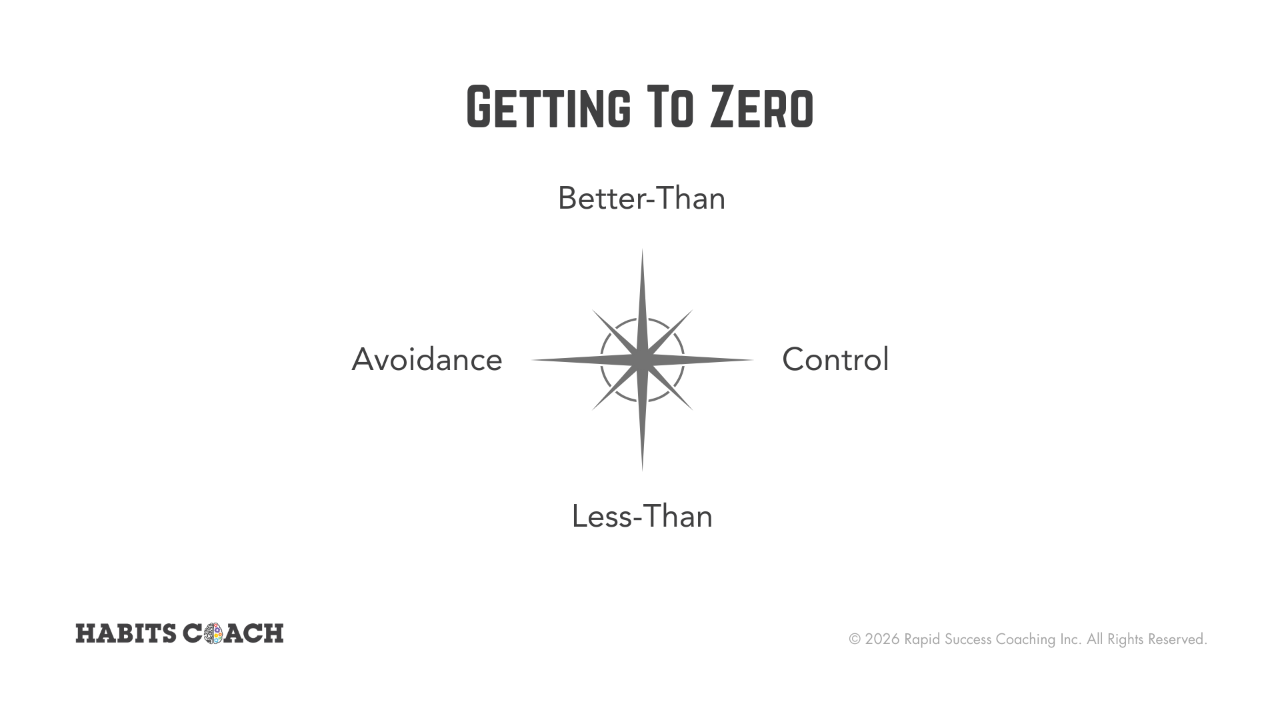
Picture a simple compass with four directions:
- Up
- Down
- Left
- Right
These aren’t labels for who you are.
They’re protective relational positions we slip into when safety, trust, or clarity drops.
Zero sits at the centre.
Zero isn’t numb.
Zero isn’t neutral.
Zero is presence without defence.
From Zero:
- You can see clearly
- You can listen without collapsing or controlling
- You can choose instead of react
Zero is where you regain authorship.
The Four Ways We Drift from Zero
Up — Better-Than
“I know better.”
“They’re wrong.”
“Let me fix this.”
Up is a better-than posture.
It’s the subtle elevation of self above others or reality.
It often looks confident — but it’s driven by control.
Control trying to pass as leadership.
Down — Less-Than
“I’m not enough.”
“I messed this up.”
“I should be better.”
Down is a less-than posture.
It’s shrinking or collapsing to preserve belonging.
This is self-abandonment in the name of safety.
Left — Avoidance
“This shouldn’t be happening.”
“I don’t want to deal with this.”
Left is avoidance.
It’s turning away from reality instead of meeting it.
Avoidance protects against feeling — but it also freezes movement.
Right — Control
“What if…?”
“I need certainty.”
“This has to work.”
Right is control.
It’s gripping the future to try to feel safe now.
Anxiety, urgency, and over-management often live here.
None of these are wrong.
They’re signals, not failures.
They tell you where safety has dropped — not who you are.
Getting to Zero & the Integrity Compass
The Integrity Compass has four dimensions:
- Intent — what I’m aiming at
- State — how I’m showing up
- Action — what I’m doing
- Impact — who this affects
Getting to Zero lives squarely in State.
When your state is distorted (Better-Than, Less-Than, Avoidance, Control):
- Intent becomes reactive
- Action becomes compulsive
- Impact becomes misaligned
You can’t think your way back to integrity.
You have to return to state first.
Zero is the reset point where:
- Intent can be clarified
- Action becomes choiceful
- Impact becomes aligned again
No amount of better habits or better communication compensates for acting from a distorted state.
Getting to Zero & the Universal Relationship Levels
Every relationship — with yourself, others, or life — moves through predictable levels:
- Safety / Threat
- Transaction / Control
- Belonging / Validation
- Self-Trust / Agency
- Unconditional Support
- Service / Stewardship
Drift happens when a relationship drops down this path in a specific context.
Zero isn’t a level on the path.
Zero is what restores enough safety to move back up.
Without Zero:
- Repair doesn’t land
- Growth feels forced
- Responsibility turns into shame
Getting to Zero & the Process: Rupture + Repair
Rupture is unavoidable:
- A misunderstanding
- A mistake
- A missed expectation
- An internal contradiction
Rupture isn’t the problem.
Skipping Zero is.
The real sequence is:
- Rupture — misalignment or break
- Return to Zero — safety, presence, orientation
- Repair — honest contact and learning
When we skip Zero:
- Apologies are mechanical
- Conversations repeat
- Habits don’t stick
- Learning doesn’t encode
Zero is the bridge between rupture and real repair.
How to Practice Getting to Zero (In Real Life)
This isn’t a long practice.
It’s something you can do in 30–60 seconds.
Step 1: Name the Relationship
Ask:
- Is this about me (self)?
- Someone else?
- Or a thing (work, money, time, health)?
Clarity starts with orientation.
Step 2: Name the Direction
Notice without judgment:
- Am I in Better-Than?
- Less-Than?
- Avoidance?
- Control?
This isn’t diagnosis — it’s navigation.
Step 3: Restore Safety
Choose one:
- Slow your breathing
- Feel your feet or body
- Relax your jaw or shoulders
- Drop the story, stay with sensation
This isn’t calming down to perform.
It’s settling your nervous system enough to come back to centre.
Zero is felt, not thought.
Step 4: Pause Before Action
From Zero, ask:
- What actually matters here?
- What relationship am I in right now?
- What would repair look like — not control?
This pause is where agency returns.
Step 5: Choose Direction — Then Act from Alignment
Getting to Zero doesn’t tell you what to do.
It gives you the capacity to choose where to go next.
From Zero, you decide the direction:
- Focus — to engage a task or do deep work
- Curiosity — to understand or reconnect in a relationship
- Courage — to name something honestly
- Care — to rest, recover, or set a boundary
Only after that choice do you act.
From alignment:
- Speak
- Decide
- Set boundaries
- Install habits
- Make plans
Action before Zero encodes protection.
Action after Zero encodes wisdom.
Zero Isn’t the Goal — It’s the Gateway
You won’t stay at Zero.
Life will pull you Up, Down, Left, and Right again.
The work isn’t avoiding drift.
The work is shortening the distance back to centre — and then choosing your direction with clarity.
That’s self-leadership.
That’s integrity.
That’s maturity.
Not perfection — but faster, kinder, more honest returns to alignment.